
![[personal profile]](https://www.dreamwidth.org/img/silk/identity/user.png)


Entry tags:
Promptmepromptly: Star Trek tropes that resonate with me
For ![[community profile]](https://www.dreamwidth.org/img/silk/identity/community.png) promptmepromptly, I got the following prompt:
promptmepromptly, I got the following prompt:
It's hard for me to tell what tropes Star Trek originated, and what it just popularized. So instead, I just decided to brainstorm some elements that frequently feature in Star Trek, and which resonate with me, and talk about them. I chose two topics:
Probably one of my favorite aspects of Star Trek is how often you will at some point get a song or live performance in the middle of an episode. Or how often various members of the crew of the ship are depicted rehearsing, performing, or attending plays or LARPing in the holodeck. It's most obvious in TNG because of Data and how he purposely practices multiple forms of art (painting, music appreciation, violin, acting, stand-up comedy, poetry, etc. etc.), and how multiple of his fellow officers assist him with these endeavors (Picard discusses literature with him and gives him feedback on his music and acting; Crusher directs him in plays and teaches him dancing; characters attend his poetry readings; etc.), and also because of the very cultured Picard who indulges his archaeology interests from time to time, regularly makes literary references, and can recite a sonnet when needed at the drop of a hat (probably inspired by Patrick Stewart's skillset).
While Data and Picard are the main examples of officers who purposely cultivate an artistic side as part of being an educated, well-rounded person, there are so many characters in TNG depicted as being similarly artistic and cultivating artistic hobbies -- Riker and his jazz trombone who also acts in plays; Crusher's aforementioned dance tutoring and theatrical directing; Worf and his Klingon opera and tea ceremonies; even a side character like O'Brien is shown to be a cellist and at one point casually performs in a string quartet, not to mention all the people like Deanna who show up to and enjoy these performances -- that it forms a sort of background fact that it is very normal for quasi-military Starfleet officers to have an appreciation for the arts.
First, I like this utopian depiction of the future where people have a lot of free/leisure time, which they can spend in holodeck escapades, reading and discussing books, rehearsing plays, enjoying concerts, and so on. Give us bread, and roses too, and all that -- part of the goodness of a good future is that everyone will be given the chance to cultivate their humanistic side. But even beyond that, I like this depiction that part of what it means to be a good Starfleet officer, in this world, is to be well-rounded.
TNG fleshes out a little bit what are the ideal traits of a Starfleet officer through the character of Wesley and other children aboard the Enterprise who are largely drawn from Starfleet families and some of whom apply for Starfleet Academy -- what education do they get and what are they tested for in their applications? From 1x19 "Coming of Age," we see that applicants are expected to have mastered the math and science needed to make complicated astrophysics and engineering calculations; however, they are also tested for their knowledge of other cultures' customs and evaluated for their psychological profile as well. In 5x06 "The Game," when Wesley returns briefly from Starfleet Academy, Picard greets him in Latin and Wesley mentions taking classes on anthropology and creative writing.
Therefore, the show establishes that both of these things are heavily valued: advanced math and science on one end, and an appreciation for culture, history, and art, and emotional maturity at the other end. The ideal officer is not just competent and decisive when needed, but also empathetic and worldly. Not only do people in the future have the time to develop themselves artistically and aesthetically, but also, having a wide range of interests and actively cultivating one's self is lauded and encouraged.
While TNG is the strongest depiction of this well-rounded officer type, it's present in other series as well. In TOS: Kirk too very much fulfills that "officer and a gentleman" archetype; in 1x07 "Charlie X," Uhura sings an improvised song while Spock accompanies her on the Vulcan lyre; in 1x13 "The Conscience of the King," the Enterprise crew watches a traveling performance of Macbeth in an episode plot that is itself very Shakespearean; in 2x24 "The Ultimate Computer," Kirk references the poem "Sea-Fever" ("All I ask is a tall ship...") (this episode also has an interesting depiction of a brilliant and ambitious scientist whose technological achievements are matched by his humanitarian values). In Voyager, both the EMH and Seven of Nine have some of Data's characteristics in that they purposely try to expand their set of experiences in order to live a richer life and obtain a broader perspective on the world, which includes reading fiction, making art, practicing social interaction, experimenting with romance and raising a family, and so on; Harry Kim plays the clarinet and is shown practicing or performing from time to time. While DS9 generally features a much scrappier cast, many of whom are not Starfleet or Federation, the two characters who best represent this ideal are probably the distinctly upper-class-coded Bashir and Garak, who regularly debate the merits of various works of art in their regular lunches. Throughout the various series, there are numerous plots that reference literary classics, from the Epic of Gilgamesh to Moby Dick (SO many Moby Dick plotlines in Star Trek).
So in short, the Star Trek world consistently depicts science to be as important as art and humanistic cultivation, which is something that obviously resonates with me because math/science/technology and art have always been my two strongest interests and I see them as very complementary rather than incompatible or trading off with each other.
I'm not sure if there is another piece of media I'm aware of that leans quite as hard into this aesthetic. There are certainly media featuring a lot of characters of this well-rounded Renaissance man archetype, but I'm not sure how many pieces of fiction embed that ideal so much into the world itself, and how many intentionally democratize that ideal rather than reserve it as the marker of a distinctly aristocratic sort of character. Right now, the closest I can think of is The Orville, which is purposely trying to capture the specifically TNG version of Star Trek and as such, makes sure to feature random concert nights and establish everyone as being up for some roleplaying in the holodeck and so on.
The other Star Trek trope I want to talk about because it resonates with me is characters who are caught between two different cultures and have to adjudicate between them, or whose character is a blend of two cultures you might think of as distinct (but their existence disproves this notion of distinctness). I've talked about this before, but I feel this resonates with my experiences of being a second-generation immigrant, but it also applies to people who are mixed race and also can function as a relatable allegory for people whose characteristics make them feel alien in their own culture (for example, neurodivergence or queer identity).
Some examples from Star Trek that stick out to me:
- Spock and his family: I feel like initially, Spock is meant to stand in as a "pure Vulcan" (or even "paradigmatic Vulcan") archetype to contrast with his Human crewmates (which itself can serve that "alien-in-one's-own-culture allegory" function mentioned above, where Spock could be interpreted as an allegory for someone neurodivergent or queer who frequently fails to "get" mainstream(/Human) culture and views it as if from the outside). However, it's later revealed that Spock is half-Human, and this dual identity is later explored in various ways throughout Star Trek media, with Spock at times leaning hard into Vulcan culture and practices and at other times estranged from it or intentionally rebelling against or rejecting it.
This is added onto in Discovery when they introduce a fully-Human adopted sister for him and also flesh out his mother Amanda's experiences and how Spock and Michael were raised on Vulcan. Michael's complicated experiences being raised Vulcan very much evoke that "neurodivergent person raised in a society that doesn't acknowledge or accommodate their differences" vibes, and her complicated, shifting Human/Vulcan identity takes on a visual manifestation through the way she styles her hair throughout the show.
This "caught between two cultures" aspect doesn't just apply to Spock (and Amanda, and Michael) but actually also to Sarek, his fully Vulcan father who is actually quite embedded in Vulcan society. Sarek himself also has to constantly weigh what he owes to his family against what he owes to society by having brought Humans or half-Humans into Vulcan society where they are not properly catered to or respected.
- Worf (and K'Ehleyr and B'Elanna and Alexander Rozhenko -- Star Trek's various Human-Klingon plotlines): Worf is very prominent for being the first Klingon in Starfleet, and most of his plotlines involve him facing the moral dilemma of what duties he has as a Starfleet officer vs. what Klingon culture demands of him.
Worf's love interest K'Ehleyr, and later, Voyager's B'Elanna, expand on this theme of uneasily bridging Federation and Klingon worlds, both of their experiences strongly contrasting with Worf's in different ways. In some ways K'Ehleyr, as a Federation ambassador to the Klingon Empire, has much more firsthand experience with and is much more fluent in Klingon culture than Worf is, despite being only half-Klingon; but in contrast to Worf's idolization of it, this familiarity has bred a kind of contempt and she is freely critical of it and doesn't feel beholden to its practices. Meanwhile, B'Elanna has very little experience with Klingon culture and is largely alienated from it, but the main role it has played in her life is only to make her feel unwieldy and unwelcome in Human society, which is a very different relationship with Klingon culture than both Worf and K'Ehleyr. Meanwhile, Worf (and his son Alexander) gets along well with his adoptive Human family, even if there may be a cultural disconnect there. These are three very different depictions of what it is to be caught between the same two cultures (Klingon and Human), and I love just how deep Star Trek is able to go in exploring this theme.
- DS9: Oh, DS9 my beloved on this point. Let's see how many characters fit this?! Actually, you know what, I would actually argue that this theme is a central if not the most central theme to this show.
-- Sisko: He is constantly negotiating between his duties and identity as an ordinary human Starfleet officer and a Bajoran religious figure.
-- Kira (and Teleny Ghemor, Ziyal, Dukat, etc.): Much of Kira's plotlines revolve around navigating the effects of Cardassia's colonization of Bajor, which has resulted in the two cultures being unpleasantly but irreversibly intertwined. From being mistaken for a Cardassian official's daughter (and subsequently adopted by him), to being entwined in the lives of children like Ziyal who are a result of Bajoran/Cardassian unions and have difficulty finding acceptance on either planet, to her long-standing hostility toward Dukat (whose own long governance of Bajor and romantic entanglement with Bajorans has partly changed his own sense of identity)... Colonization inevitably leads to a two-way mutual influence on culture, where the imperial power obviously imposes its culture on the colony, but also members of the colony frequently immigrate to the imperial power, yielding a two-way influence. Throughout the show, it is also argued that Bajor has an important role to play in fixing Cardassia's problems as one of its former colonies; without Bajorans calling out what Cardassia did, Cardassia is unable to recognize where it went wrong and so cannot become a better place (1x19 "Duet"; 7x22 "Tacking into the Wind").
-- Odo: Odo is constantly torn between his own individual sense of justice and his loyalty to and desire to rejoin his people.
-- Garak and Quark: Both of these characters are what I would describe as unabashed chauvinists for their own culture who, by being beholden to Federation and Bajoran laws and practices, gradually find themselves outsiders in their own culture, having partly adopted/absorbed these more liberal Federation values. Many of their plotlines involve them trying futilely to win acceptance among their old peers to the disappointment of their new friends.
-- Jadzia's (and Curzon's, and Ezri's) relationship to Klingon culture has also created some moral dilemmas for her and intersects interestingly with Worf's peculiar relationship to Klingon culture.
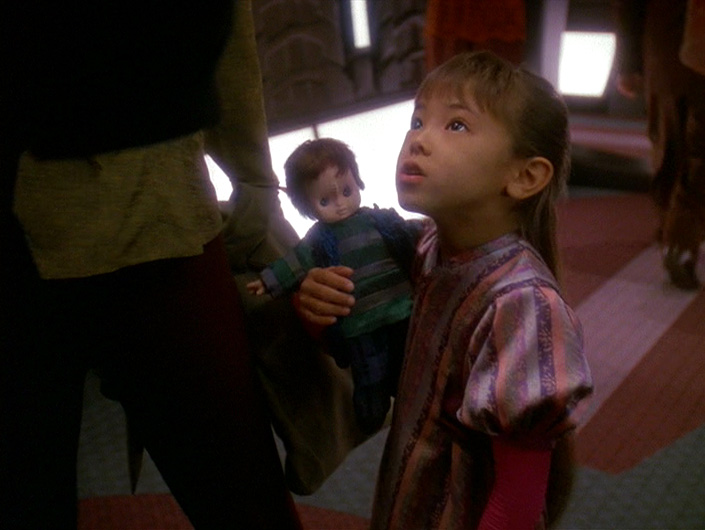
In general, DS9 -- the station -- is an incredibly multicultural melting pot. Cardassian in design, run jointly by Federation and Bajoran governments, with the shapeshifter security chief and the Ferengi-run gambling house having continuity from the Cardassian occupation, etc. etc. Even relatively minor details like Molly's Bajoran doll (4x17 "Accession"), Jake's appeals to trends on Bajor and casual interspecies dating, and Keiko's attempts to create a curriculum for a multispecies classroom (1x20 "In the Hands of the Prophets") establish that this place exists at the intersection of many different cultures.
- Seven of Nine: While Human, Seven has spent most of her life as a Borg and often still brings a Borg perspective to the way she views things, from her dislike of solitude to her struggles with developing a sense of individuality, to her puzzlement at pointless inefficiencies. While, as an ex-Borg, she is striving to get in touch with a human side of herself that she has been forcibly estranged from, she also establishes that the Borg way of seeing things is not necessarily bad, simply different.
- Lower Decks plays with this theme a bit with D'Vana Tendi who is definitely a black sheep among Orions who is off doing her own weird little thing, but who can seamlessly "code-switch" when she's around family and is also intensely aware of (and awkward about) stereotypes and expectations people have of Orions, which she knows she doesn't really fulfill (although she could, although it would be kinda fake).
I kind of wonder if Gene Roddenberry's military experience is partly responsible for how much Star Trek reckons with these "straddling two worlds" type themes/plotlines. Being in a highly hierarchical military "chain of command" structure means that there are steep penalties for not carrying out direct orders. But of course people are not *only* soldiers but also full human beings, and other conflicting considerations can immediately present themselves: the person's own ethical/moral code; multiple laws governing behavior that a soldier is also beholden to; the identity they might also occupy as a father or sister or citizen or whatever else that gives them another perspective on their orders aside from that they must simply be followed. I think being put in this kind of situation causes someone to develop a kind of split sense of identity where values and what is the right/most appropriate thing to do in a particular situation have to be constantly negotiated and renegotiated, which can resemble to at least some degree the experience of being an immigrant, or mixed race, or an oppressed minority, etc. -- in the latter case, the condition of belonging to both an oppressed minority identity and a larger identity containing that smaller identity and which is often actively hostile toward that smaller identity (for example, being both African-American AND American) leads to double consciousness, which shares those traits of seeing the world through two different, incompatible lenses and of constant negotiation of identity.
So I kind of see this "caught between worlds" theme possibly springing both from Roddenberry's military experience and also his left-wing commitment to a united world government, which requires this delicate balance between everyone aligning their values so that cooperation and shared projects are possible, and a commitment to pluralism that accommodates cultural diversity that sometimes can't and/or shouldn't be reconciled. This is a difficult balance to achieve that is best represented by some of these memorable Star Trek characters and plotlines.
Off the top of my head, other media I've seen that feature a similar level of cultural negotiation include:
- Avatar: The Last Airbender / Legend of Korra: While most of the nations here seem pretty neatly divided up by element, there is a lot of cultural mixing and also diversity within a single nation. The Northern Water Tribe is pretty culturally distinct from the Southern Water Tribe, which are very distinct from swamp waterbenders. The main characters travel between nations, their hair and dress changing to match local fashions, and Zuko and Iroh spend quite a bit of time making a quiet life in the Earth Kingdom, where they are taken to be Earth Kingdom citizens, and people do not realize that they are Fire Nation (and quite prominent members of the Fire Nation at that!). As Avatar, Aang learns the bending traditions of various places, and his pacifism and very cosmopolitan friendships from his old life are at odds with a new world at war. Many times you see the Avatar torn between their responsibilities as Avatar vs. their bonds with the people from their home nation that they knew in childhood. The show also deals with colonialism, where the Fire Nation has colonies in the Earth Kingdom. Legend of Korra extends these themes with its focus on the multicultural Republic City (formed from those colonies) and exploring the mixed-element family of Mako and Bolin.
- A Song of Ice and Fire: I don't have time to go into every place where this theme pops up so I'll just mention that I like the way that Westeros has these various layers of ethnic groups and religions that all still exist in Westeros, and sometimes have blended to the point where the identity seems unified, but sometimes have not and those distinctions are still felt as relevant. Children of the forest, First Men, Ironborn, Andals, Rhoynar, blood of Old Valyria, etc.; the old gods, the Seven, the Drowned God, R'hllor. Theon Greyjoy's split Ironborn / House Stark identity and loyalty; Stannis's conversion to the faith of R'hllor; the uneasy relationship between the house of Targaryen that practices incest and the Faith of the Seven that despises it -- these are all elements of ASOIAF that interest me. So is Daenerys's complex identity as someone who views Westeros as her birthright; who thinks of a Braavosi house with a red door as her home; who married into a khalasar and speaks fluent Dothraki. Also, in some sense, the hierarchy of feudalism imposes conflicting demands on someone very similar to military chain of command, and this conflict frequently crops up in various characters' stories, such as Jaime's decision to break his Kingsguard oaths in order to save innocent lives.
- Mm... Most media featuring Asian-American immigrants? Turning Red, Ms. Marvel, Elemental, etc. all feature a young person trying to define their identity, usually caught between their parents' "old world" expectations and the shiny possibilities of the "new world." (I know Turning Red is set in Canada, but the same principle applies.) A lot of recent immigration from Asian countries + cultures of filial piety or just generally more close-knit families + immigrant parents' general desire for their children to find stable, high-status, lucrative employment (doctor, lawyer, engineer are the common types) vs. their children's (i.e. the filmmaker's, the storyteller's, etc.) attraction to more high-risk artsy careers, all lend themselves to stories where characters have to balance the expectations of their family with their own personality/values, which were shaped by a very different country from what their parents grew up in, and those characters have to find identity in a world where they are a cultural outsider.
I'm sure there are a ton of other examples, including in sci-fi/fantasy genre works, especially ones that focus on large multicultural cities (ports, etc.). These are just some that sprang to mind for me.
promptmepromptly, I got the following prompt:What tropes that came from Star Trek have resonated most with you as a viewer, possibly with examples of them in alternate medias? If that scope is too broad, feel free to pick a trope and talk my ear off about it.
It's hard for me to tell what tropes Star Trek originated, and what it just popularized. So instead, I just decided to brainstorm some elements that frequently feature in Star Trek, and which resonate with me, and talk about them. I chose two topics:
Humanistic Renaissance man (gender neutral) / random ship concerts and plays / "an officer and a gentleman" (gender neutral)
Probably one of my favorite aspects of Star Trek is how often you will at some point get a song or live performance in the middle of an episode. Or how often various members of the crew of the ship are depicted rehearsing, performing, or attending plays or LARPing in the holodeck. It's most obvious in TNG because of Data and how he purposely practices multiple forms of art (painting, music appreciation, violin, acting, stand-up comedy, poetry, etc. etc.), and how multiple of his fellow officers assist him with these endeavors (Picard discusses literature with him and gives him feedback on his music and acting; Crusher directs him in plays and teaches him dancing; characters attend his poetry readings; etc.), and also because of the very cultured Picard who indulges his archaeology interests from time to time, regularly makes literary references, and can recite a sonnet when needed at the drop of a hat (probably inspired by Patrick Stewart's skillset).
While Data and Picard are the main examples of officers who purposely cultivate an artistic side as part of being an educated, well-rounded person, there are so many characters in TNG depicted as being similarly artistic and cultivating artistic hobbies -- Riker and his jazz trombone who also acts in plays; Crusher's aforementioned dance tutoring and theatrical directing; Worf and his Klingon opera and tea ceremonies; even a side character like O'Brien is shown to be a cellist and at one point casually performs in a string quartet, not to mention all the people like Deanna who show up to and enjoy these performances -- that it forms a sort of background fact that it is very normal for quasi-military Starfleet officers to have an appreciation for the arts.
First, I like this utopian depiction of the future where people have a lot of free/leisure time, which they can spend in holodeck escapades, reading and discussing books, rehearsing plays, enjoying concerts, and so on. Give us bread, and roses too, and all that -- part of the goodness of a good future is that everyone will be given the chance to cultivate their humanistic side. But even beyond that, I like this depiction that part of what it means to be a good Starfleet officer, in this world, is to be well-rounded.
TNG fleshes out a little bit what are the ideal traits of a Starfleet officer through the character of Wesley and other children aboard the Enterprise who are largely drawn from Starfleet families and some of whom apply for Starfleet Academy -- what education do they get and what are they tested for in their applications? From 1x19 "Coming of Age," we see that applicants are expected to have mastered the math and science needed to make complicated astrophysics and engineering calculations; however, they are also tested for their knowledge of other cultures' customs and evaluated for their psychological profile as well. In 5x06 "The Game," when Wesley returns briefly from Starfleet Academy, Picard greets him in Latin and Wesley mentions taking classes on anthropology and creative writing.
Therefore, the show establishes that both of these things are heavily valued: advanced math and science on one end, and an appreciation for culture, history, and art, and emotional maturity at the other end. The ideal officer is not just competent and decisive when needed, but also empathetic and worldly. Not only do people in the future have the time to develop themselves artistically and aesthetically, but also, having a wide range of interests and actively cultivating one's self is lauded and encouraged.
While TNG is the strongest depiction of this well-rounded officer type, it's present in other series as well. In TOS: Kirk too very much fulfills that "officer and a gentleman" archetype; in 1x07 "Charlie X," Uhura sings an improvised song while Spock accompanies her on the Vulcan lyre; in 1x13 "The Conscience of the King," the Enterprise crew watches a traveling performance of Macbeth in an episode plot that is itself very Shakespearean; in 2x24 "The Ultimate Computer," Kirk references the poem "Sea-Fever" ("All I ask is a tall ship...") (this episode also has an interesting depiction of a brilliant and ambitious scientist whose technological achievements are matched by his humanitarian values). In Voyager, both the EMH and Seven of Nine have some of Data's characteristics in that they purposely try to expand their set of experiences in order to live a richer life and obtain a broader perspective on the world, which includes reading fiction, making art, practicing social interaction, experimenting with romance and raising a family, and so on; Harry Kim plays the clarinet and is shown practicing or performing from time to time. While DS9 generally features a much scrappier cast, many of whom are not Starfleet or Federation, the two characters who best represent this ideal are probably the distinctly upper-class-coded Bashir and Garak, who regularly debate the merits of various works of art in their regular lunches. Throughout the various series, there are numerous plots that reference literary classics, from the Epic of Gilgamesh to Moby Dick (SO many Moby Dick plotlines in Star Trek).
So in short, the Star Trek world consistently depicts science to be as important as art and humanistic cultivation, which is something that obviously resonates with me because math/science/technology and art have always been my two strongest interests and I see them as very complementary rather than incompatible or trading off with each other.
I'm not sure if there is another piece of media I'm aware of that leans quite as hard into this aesthetic. There are certainly media featuring a lot of characters of this well-rounded Renaissance man archetype, but I'm not sure how many pieces of fiction embed that ideal so much into the world itself, and how many intentionally democratize that ideal rather than reserve it as the marker of a distinctly aristocratic sort of character. Right now, the closest I can think of is The Orville, which is purposely trying to capture the specifically TNG version of Star Trek and as such, makes sure to feature random concert nights and establish everyone as being up for some roleplaying in the holodeck and so on.
Characters caught between different cultures
The other Star Trek trope I want to talk about because it resonates with me is characters who are caught between two different cultures and have to adjudicate between them, or whose character is a blend of two cultures you might think of as distinct (but their existence disproves this notion of distinctness). I've talked about this before, but I feel this resonates with my experiences of being a second-generation immigrant, but it also applies to people who are mixed race and also can function as a relatable allegory for people whose characteristics make them feel alien in their own culture (for example, neurodivergence or queer identity).
Some examples from Star Trek that stick out to me:
- Spock and his family: I feel like initially, Spock is meant to stand in as a "pure Vulcan" (or even "paradigmatic Vulcan") archetype to contrast with his Human crewmates (which itself can serve that "alien-in-one's-own-culture allegory" function mentioned above, where Spock could be interpreted as an allegory for someone neurodivergent or queer who frequently fails to "get" mainstream(/Human) culture and views it as if from the outside). However, it's later revealed that Spock is half-Human, and this dual identity is later explored in various ways throughout Star Trek media, with Spock at times leaning hard into Vulcan culture and practices and at other times estranged from it or intentionally rebelling against or rejecting it.
This is added onto in Discovery when they introduce a fully-Human adopted sister for him and also flesh out his mother Amanda's experiences and how Spock and Michael were raised on Vulcan. Michael's complicated experiences being raised Vulcan very much evoke that "neurodivergent person raised in a society that doesn't acknowledge or accommodate their differences" vibes, and her complicated, shifting Human/Vulcan identity takes on a visual manifestation through the way she styles her hair throughout the show.
This "caught between two cultures" aspect doesn't just apply to Spock (and Amanda, and Michael) but actually also to Sarek, his fully Vulcan father who is actually quite embedded in Vulcan society. Sarek himself also has to constantly weigh what he owes to his family against what he owes to society by having brought Humans or half-Humans into Vulcan society where they are not properly catered to or respected.
- Worf (and K'Ehleyr and B'Elanna and Alexander Rozhenko -- Star Trek's various Human-Klingon plotlines): Worf is very prominent for being the first Klingon in Starfleet, and most of his plotlines involve him facing the moral dilemma of what duties he has as a Starfleet officer vs. what Klingon culture demands of him.
Worf's love interest K'Ehleyr, and later, Voyager's B'Elanna, expand on this theme of uneasily bridging Federation and Klingon worlds, both of their experiences strongly contrasting with Worf's in different ways. In some ways K'Ehleyr, as a Federation ambassador to the Klingon Empire, has much more firsthand experience with and is much more fluent in Klingon culture than Worf is, despite being only half-Klingon; but in contrast to Worf's idolization of it, this familiarity has bred a kind of contempt and she is freely critical of it and doesn't feel beholden to its practices. Meanwhile, B'Elanna has very little experience with Klingon culture and is largely alienated from it, but the main role it has played in her life is only to make her feel unwieldy and unwelcome in Human society, which is a very different relationship with Klingon culture than both Worf and K'Ehleyr. Meanwhile, Worf (and his son Alexander) gets along well with his adoptive Human family, even if there may be a cultural disconnect there. These are three very different depictions of what it is to be caught between the same two cultures (Klingon and Human), and I love just how deep Star Trek is able to go in exploring this theme.
- DS9: Oh, DS9 my beloved on this point. Let's see how many characters fit this?! Actually, you know what, I would actually argue that this theme is a central if not the most central theme to this show.
-- Sisko: He is constantly negotiating between his duties and identity as an ordinary human Starfleet officer and a Bajoran religious figure.
-- Kira (and Teleny Ghemor, Ziyal, Dukat, etc.): Much of Kira's plotlines revolve around navigating the effects of Cardassia's colonization of Bajor, which has resulted in the two cultures being unpleasantly but irreversibly intertwined. From being mistaken for a Cardassian official's daughter (and subsequently adopted by him), to being entwined in the lives of children like Ziyal who are a result of Bajoran/Cardassian unions and have difficulty finding acceptance on either planet, to her long-standing hostility toward Dukat (whose own long governance of Bajor and romantic entanglement with Bajorans has partly changed his own sense of identity)... Colonization inevitably leads to a two-way mutual influence on culture, where the imperial power obviously imposes its culture on the colony, but also members of the colony frequently immigrate to the imperial power, yielding a two-way influence. Throughout the show, it is also argued that Bajor has an important role to play in fixing Cardassia's problems as one of its former colonies; without Bajorans calling out what Cardassia did, Cardassia is unable to recognize where it went wrong and so cannot become a better place (1x19 "Duet"; 7x22 "Tacking into the Wind").
-- Odo: Odo is constantly torn between his own individual sense of justice and his loyalty to and desire to rejoin his people.
-- Garak and Quark: Both of these characters are what I would describe as unabashed chauvinists for their own culture who, by being beholden to Federation and Bajoran laws and practices, gradually find themselves outsiders in their own culture, having partly adopted/absorbed these more liberal Federation values. Many of their plotlines involve them trying futilely to win acceptance among their old peers to the disappointment of their new friends.
-- Jadzia's (and Curzon's, and Ezri's) relationship to Klingon culture has also created some moral dilemmas for her and intersects interestingly with Worf's peculiar relationship to Klingon culture.
In general, DS9 -- the station -- is an incredibly multicultural melting pot. Cardassian in design, run jointly by Federation and Bajoran governments, with the shapeshifter security chief and the Ferengi-run gambling house having continuity from the Cardassian occupation, etc. etc. Even relatively minor details like Molly's Bajoran doll (4x17 "Accession"), Jake's appeals to trends on Bajor and casual interspecies dating, and Keiko's attempts to create a curriculum for a multispecies classroom (1x20 "In the Hands of the Prophets") establish that this place exists at the intersection of many different cultures.
- Seven of Nine: While Human, Seven has spent most of her life as a Borg and often still brings a Borg perspective to the way she views things, from her dislike of solitude to her struggles with developing a sense of individuality, to her puzzlement at pointless inefficiencies. While, as an ex-Borg, she is striving to get in touch with a human side of herself that she has been forcibly estranged from, she also establishes that the Borg way of seeing things is not necessarily bad, simply different.
- Lower Decks plays with this theme a bit with D'Vana Tendi who is definitely a black sheep among Orions who is off doing her own weird little thing, but who can seamlessly "code-switch" when she's around family and is also intensely aware of (and awkward about) stereotypes and expectations people have of Orions, which she knows she doesn't really fulfill (although she could, although it would be kinda fake).
I kind of wonder if Gene Roddenberry's military experience is partly responsible for how much Star Trek reckons with these "straddling two worlds" type themes/plotlines. Being in a highly hierarchical military "chain of command" structure means that there are steep penalties for not carrying out direct orders. But of course people are not *only* soldiers but also full human beings, and other conflicting considerations can immediately present themselves: the person's own ethical/moral code; multiple laws governing behavior that a soldier is also beholden to; the identity they might also occupy as a father or sister or citizen or whatever else that gives them another perspective on their orders aside from that they must simply be followed. I think being put in this kind of situation causes someone to develop a kind of split sense of identity where values and what is the right/most appropriate thing to do in a particular situation have to be constantly negotiated and renegotiated, which can resemble to at least some degree the experience of being an immigrant, or mixed race, or an oppressed minority, etc. -- in the latter case, the condition of belonging to both an oppressed minority identity and a larger identity containing that smaller identity and which is often actively hostile toward that smaller identity (for example, being both African-American AND American) leads to double consciousness, which shares those traits of seeing the world through two different, incompatible lenses and of constant negotiation of identity.
So I kind of see this "caught between worlds" theme possibly springing both from Roddenberry's military experience and also his left-wing commitment to a united world government, which requires this delicate balance between everyone aligning their values so that cooperation and shared projects are possible, and a commitment to pluralism that accommodates cultural diversity that sometimes can't and/or shouldn't be reconciled. This is a difficult balance to achieve that is best represented by some of these memorable Star Trek characters and plotlines.
Off the top of my head, other media I've seen that feature a similar level of cultural negotiation include:
- Avatar: The Last Airbender / Legend of Korra: While most of the nations here seem pretty neatly divided up by element, there is a lot of cultural mixing and also diversity within a single nation. The Northern Water Tribe is pretty culturally distinct from the Southern Water Tribe, which are very distinct from swamp waterbenders. The main characters travel between nations, their hair and dress changing to match local fashions, and Zuko and Iroh spend quite a bit of time making a quiet life in the Earth Kingdom, where they are taken to be Earth Kingdom citizens, and people do not realize that they are Fire Nation (and quite prominent members of the Fire Nation at that!). As Avatar, Aang learns the bending traditions of various places, and his pacifism and very cosmopolitan friendships from his old life are at odds with a new world at war. Many times you see the Avatar torn between their responsibilities as Avatar vs. their bonds with the people from their home nation that they knew in childhood. The show also deals with colonialism, where the Fire Nation has colonies in the Earth Kingdom. Legend of Korra extends these themes with its focus on the multicultural Republic City (formed from those colonies) and exploring the mixed-element family of Mako and Bolin.
- A Song of Ice and Fire: I don't have time to go into every place where this theme pops up so I'll just mention that I like the way that Westeros has these various layers of ethnic groups and religions that all still exist in Westeros, and sometimes have blended to the point where the identity seems unified, but sometimes have not and those distinctions are still felt as relevant. Children of the forest, First Men, Ironborn, Andals, Rhoynar, blood of Old Valyria, etc.; the old gods, the Seven, the Drowned God, R'hllor. Theon Greyjoy's split Ironborn / House Stark identity and loyalty; Stannis's conversion to the faith of R'hllor; the uneasy relationship between the house of Targaryen that practices incest and the Faith of the Seven that despises it -- these are all elements of ASOIAF that interest me. So is Daenerys's complex identity as someone who views Westeros as her birthright; who thinks of a Braavosi house with a red door as her home; who married into a khalasar and speaks fluent Dothraki. Also, in some sense, the hierarchy of feudalism imposes conflicting demands on someone very similar to military chain of command, and this conflict frequently crops up in various characters' stories, such as Jaime's decision to break his Kingsguard oaths in order to save innocent lives.
- Mm... Most media featuring Asian-American immigrants? Turning Red, Ms. Marvel, Elemental, etc. all feature a young person trying to define their identity, usually caught between their parents' "old world" expectations and the shiny possibilities of the "new world." (I know Turning Red is set in Canada, but the same principle applies.) A lot of recent immigration from Asian countries + cultures of filial piety or just generally more close-knit families + immigrant parents' general desire for their children to find stable, high-status, lucrative employment (doctor, lawyer, engineer are the common types) vs. their children's (i.e. the filmmaker's, the storyteller's, etc.) attraction to more high-risk artsy careers, all lend themselves to stories where characters have to balance the expectations of their family with their own personality/values, which were shaped by a very different country from what their parents grew up in, and those characters have to find identity in a world where they are a cultural outsider.
I'm sure there are a ton of other examples, including in sci-fi/fantasy genre works, especially ones that focus on large multicultural cities (ports, etc.). These are just some that sprang to mind for me.
no subject
(And if you have a site you archive on, you totally should as a Meta work!)
no subject
no subject
no subject
no subject
no subject