
![[personal profile]](https://www.dreamwidth.org/img/silk/identity/user.png)



Entry tags:
100 Disney Things [005]: Common Criticisms of The Little Mermaid
100 Disney Things [005]

Oh man, I am getting too busy for these posts. This one's been sitting on my hard drive for a while, and I've only now gotten around to cleaning it up. Basically, it's sort of a rebuttal/examination of the common criticisms that get lobbed at The Little Mermaid, plus my own thoughts on the movie and Ariel as a character. It's an evaluation of The Little Mermaid and Ariel, from a feminist perspective, but hopefully much more in-depth than what you usually see on the Internet or in a media studies class... (And sort of ranty.)
The more I think about The Little Mermaid, the more I feel like it's been somehow criticism-proofed. As in, it's like they knew exactly what people would criticize about the movie over and over again and specifically put in scenes to THWART THAT CRITICISM. Examples:
• As if they knew that people would criticize Ariel for wanting to be a human for love, they put in Ariel's big "I want" song, "Part of Your World," before she even knew Eric existed.
• As if they knew that people would criticize Ariel for leaving her "loving father and sisters" for a man, they put in a traumatic scene where King Triton destroys all of Ariel's most prized possessions in a rage. They also put in a line where Ariel asks Ursula if being a human means she'll never get to see her father or sisters again. "Life's full of tough choices, innit?" is Ursula's response. Ariel weighed it. Her decision wasn't about blindly choosing Eric over family but about making a clean break, deciding to run away from home to a new life -- permanently, if need be. (Admittedly, it was kind of a gamble that Eric would turn out to be an overall good person and also interested in her, and also admittedly it's a little iffy that Ariel's goals of being human and being with Eric become pretty much merged after she saves him from the shipwreck -- that muddles the waters a bit in understanding why Ariel struck the bargain in the first place. But in any case, Ariel only struck the bargain with Ursula after Triton destroyed her grotto. This is important!)
• As if they knew that people would criticize Eric for only liking Ariel for her looks, they put in a whole date montage where Ariel is able to clearly convey her personality through her actions.
• As if they knew that people would complain about Eric heartlessly choosing another girl over Ariel after she made all those sacrifices for him, they put in a scene where he decides to give up on his mystery singing girl in favor of Ariel, only to have Ursula hypnotize him right after. Like, this is the one that strikes me as particularly prescient. Not content with Eric simply encountering a woman with the right voice and that changing his mind, they took extra measures to show that Eric chose Ariel, and then made it so that Ursula only changes his mind by hypnotizing him.
Too bad about 75% of the Internet seems to not remember these scenes.
That isn't to say that there's nothing in this movie that can be criticized, but just that the types of critiques that you hear a lot must be made by people with a fuzzy recollection of the film, since, like... they're dealt with in the film itself.
In more detail, here's how the "problematic storyline" of The Little Mermaid goes:
Ariel's hobby is collecting human artifacts. At the beginning of the film, she skips concert practice to go trawling through a shipwreck looking for interesting items to add to her collection.
She then goes to the surface to consult Scuttle about the unfamiliar objects. She is later scolded by Triton for this because of the danger of merfolk going to the surface. He tells her never to do it again. She doesn't acquiesce, and instead swims off tearfully.
In her secret grotto, she sings about how she longs to be part of the human world. Afterwards, she goes to the surface, sees Eric's ship, and falls in love with him. There's a storm and the ship ends up catching on fire. Eric goes back to the burning ship to save his dog. However, he's flung into the sea where Ariel saves him and brings him to shore.
She sings to him but leaves before he's able to clearly see her face. Here, "Part of Your World" reprises and becomes about wanting to stay with Eric and be part of his world specifically. From this point on, Ariel's desire to be human becomes melded with her desire to be with Eric.
Flounder finds Prince Eric's statue and presents it to Ariel. Triton shows up at the grotto and they argue. Ariel lets slip that she loves Eric. A furious Triton blasts everything in her grotto, leaving a crying Ariel.
Flotsam and Jetsam show up offering Ariel a way to be with Eric. She goes to Ursula who gives her this deal:
She gets: Human form
On the condition that: She gets True Love's Kiss from the Prince before sunset on the third day
Price: Her voice
If she fails to meet condition: She becomes Ursula's property (a polyp)
Ariel accepts. In essence, Ursula is giving her one desire (human body) on the condition that Ariel gets her other desire (Eric's love) to happen too, so she either wins twice or forfeits her freedom in trying to make her own dreams come true. She gives up her voice, which at various points in the movie is described as particularly beautiful (by Sebastian and Eric), so arguably she is giving up her "greatest possession". However, there's no indication that Ariel herself values her singing voice any more than, you know, any person would value their ability to talk. Remember, she skipped music practice earlier to go hunting for human artifacts.
After that, Ariel becomes human and Eric finds her and takes her in, they have dinner together, Ariel is like a kid in a candy store, etc. etc. The next day they go on a ride through the kingdom, Eric starts to fall for her, and they almost kiss, but Ursula sabotages it. That night, Eric decides to stop mooning after the Mystery Voice Girl. Ironically, Mystery Voice Girl shows up but it's Ursula and actually she's hypnotizing him.
The next day, their marriage is announced and Ariel's heart is broken. Upon hearing that Vanessa is Ursula, though, she decides to not give up. Scuttle breaks Ursula's shell, Ariel's voice returns to her, Eric breaks free from the spell, and they almost kiss again, but time runs out, so Ursula takes mermaid Ariel back into the ocean where Triton shows up and trades his life for Ariel's. Eric shows up and eventually kills Ursula.
Triton, finally understanding his daughter's feelings, turns her human again.
The important thing to note here is that The Little Mermaid, unlike Cinderella, Beauty and the Beast, Pocahontas, etc. is not a love story about Ariel and Eric. It's a coming-of-age story about Ariel and Triton. It's about their loving but rocky relationship and how Triton eventually comes to understand his daughter and realize that she's grown up while he wasn't looking, and to let her go in the end.
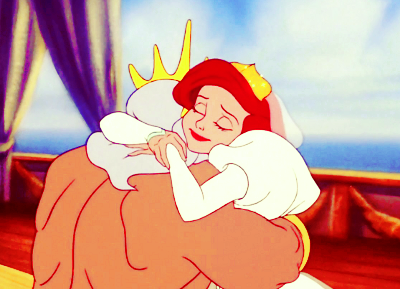
The whole movie builds up to this moment -- when Ariel says, "I love you, Daddy."
Ariel's turning human is partly about making her dreams come true, partly about finding love, but also partly an act that can only really be compared to "running away from home." If The Little Mermaid took place in modern times, the climax of the first act of the movie would essentially be Ariel getting into a huge row with her father, him throwing a tantrum and trashing her room, and then her deciding she absolutely does not want to stay there anymore and running away. (To "Auntie Ursula" who promises her the dream life in the Big City, everything Ariel wanted! Except it comes with a catch. ...This would make an awesome AU.)
I think there is valid criticism in having the motivation and goals for Ariel's actions be men on both ends -- her motivation for leaving comes from her father, and her objective once she becomes human is related to Eric. However, this doesn't seem particularly horrible other than just the lack of female presence in the storyline. Also, I think there is valid criticism in that she ends up more dependent and passive after becoming human. For example:
• The condition of the spell means everything hinges on Eric's actions -- she is therefore reliant on him.
• When the wedding is going down, the animals (Sebastian, Flounder, Scuttle, and Max) are the ones who take all the action. What bugs me about this part is that Ariel can't even swim anymore. She jumps into the water to get to Eric but needs to hold onto a barrel to float and needs Flounder to pull her through the water. She doesn't even kick her legs or anything, a complete reversal from when she was a mermaid. I suppose you could argue that maybe she only knows how to use a tail to swim and can't figure out how to make human legs move the same way. Or that this was an intentional creative choice to contrast Ariel's mermaid world/body/skills she sacrificed with the human world/body/skills she received in exchange. Still, I do not particularly like this creative decision, since it's such a reversal from Ariel's active and physically-oriented personality shown in the first scene, and I don't think it would have hurt the movie very much to at least show her kicking.
• She ends up being saved by Eric in the final scene, a reversal from earlier when she saved him. Not really bad by itself (I mean, it's not like you're not allowed to be saved by anyone ever or you're a Bad Female Role Model OMG!!), but these three things together do show a progression from Ariel going from a very active state at the beginning of the movie to becoming noticeably more passive by the end.
Another valid criticism for this movie is that Ariel falls in love instantly, and True Love is achieved in about 1.5 days. However, this isn't exactly uncommon in Disney movies... or just movies in general, which tend to be very fast-paced/condensed when it comes to romance, and plot in general.
There is also semi-valid criticism in that Ariel is silenced during the latter half of the movie. I don't think there's a negative message in here, though, like, "Women should or have to give up their right to speak in order to get a man!" or "Hey, Ariel had a happy ending by giving up her voice so you should do that too!" I can see how the loss of her voice would make people uncomfortable, because she loses her ability to express her thoughts, communicate, protest, make a scene, etc. And combined with my earlier critique that Act II!Ariel is more passive than Act I!Ariel, it might remind people uncomfortably of cultural expectations that women be quiet and passive (lampshaded by Ursula's lines during "Poor Unfortunate Souls" -- "Yet on land it's much preferred for ladies not to say a word [...] But they dote and swoon and fawn / on a lady who's withdrawn / It's she who holds her tongue who gets a man"). But I think it's inaccurate to say the movie is implying that that's right or the way things should be. Sure, Ariel does lose her voice and ends up getting the prince, but it's portrayed in the movie as a disadvantage/challenge Ursula set up, NOT a positive thing that helps Ariel find love. In essence, the way I view Ariel's sacrifice is that it's sort of... Faustian? Not sure what the right word to use is. But she's basically playing a high-stakes gambling game with a devil who will use tricks to make sure she never wins.
My final critique is that I do think Ariel's body shape is sort of problematic. While it's not unusual for a cartoon character to have a tiny waist compared to their head (because cartoon characters tend to have big heads and be pretty stylized), the way Ariel's waist narrows is just... not realistic. In order to do that, you either need clothing that shapes your waist such as a corset (which Ariel doesn't have as a mermaid) or you need to be constantly sucking in your waist (which is just a silly thing to do). My minor nitpick.
So to sum up my thoughts on The Little Mermaid and critiques I read of The Little Mermaid... I generally get frustrated by critiques of this movie because I think what a lot of them miss is that, when Ariel makes her deal with Ursula, while she is doing it to get a man, even more important than that, she is doing it for her own chance at happiness. Women taking risks or making mistakes while striving to achieve personal happiness -- I'm not quite sure how this is a "bad message"? If the main character were male, we'd view them as a brave, heroic figure who made sacrifices for their dream, and those sacrifices paid off.
As for my evaluation of Ariel, I find her to be one of Disney's strongest heroines in the sense that overall she is a very active character -- this is undoubtedly her story, and her desires and her actions take center stage. I also think she's pretty interesting because she's meant to be largely sympathetic, but she has her share of real flaws as well (impulsiveness, rebelliousness, etc.). I find real flaws like this much more compelling than faux flaws like being clumsy or being an outcast or being ugly-but-sekritly-beautiful or whatnot. I had trouble digging Ariel when I was younger because I didn't relate to her at all (since I never had a rebellious phase and I get along with my parents pretty well), but now that I'm older I kind of appreciate the fact that she IS different from me, with different circumstances, and a different personality. It makes it more interesting to try to understand and empathize with her.
EDIT: Lol, I just saw a link to this on Tumblr. While yes I agree Ariel's actions screwed other people over, this sentence is the epitome of everything I hate about TLM analysis: "She gives up her whole life, the one thing that makes her really special (her voice), her family, her friends, everything she knows, just so she can be with Eric. She changes her species for a guy she’s never even met!" NO. STOP.
Also, regarding trusting Ursula, I should note that if Ariel and Triton hadn't been so strained in their relationship, Triton could very easily and painlessly have given her a human body (this is, after all, what he does at the end of the movie). But convinced she had a snowball's chance of convincing her dad to do that, she turned to the only other person who apparently had the ability to do it. You can view it as a metaphor of sorts that if you outright ban someone from doing something that they really really want to do, most likely they will end up doing it behind your back anyway and in a more dangerous way than if you had just allowed the possibility.
You can suggest topics for future posts for this meme over here.
no subject
My main issue is how it does focus mainly on Eric in the latter half of the movie. The song at the beginning seems more like a failed effort to make us think there's more to her to me, as it isn't reinforced later... or only reinforces how she fangirls over objects. She does find things on land interesting to a degree, but she seems to lack curiosity about anything which isn't either a. Eric or B. an object... I view her more as a vapid fangirl collector than anything. Why be fascinated by a world she clearly knows nothing about other than "oohh, they have shiny objects?" And the scene on the boat actually drives me crazy, because while he can tell part of her personality, he still knows nothing about her other than a couple of traits. Also reinforcing the focus being on Eric, Ursula doesn't entice Ariel with becoming human to escape her father (this is never mentioned from what I recall) or her own society (which really isn't that bad at all and which she seems to fit in quite well otherwise-- she definitely isn't a social outcast who dislikes her own culture by any means), she entices her with this man she just met and "is in love with" presumably only because he's human... I actually feel like she treats him like another one of her objects to collect.
I definitely wouldn't give Triton father of the year, but he did have good intentions ultimately, as it's clear he does care for her but just goes around it the wrong way, considering how he knows how dangerous humans can be. I actually find his character development much more interesting than Ariel's throughout the movie in this regard, as he realizes his mistakes while she... doesn't express any guilt all from being fooled by what is obviously a deal with the octopus-devil. Besides, her sea creature friends are loving and care for her, but she betrays their wishes as well. She also just seems to be in that annoying "rebellious teenager who will rebel against anything without a cause" phase. Admittedly, a part of it might also be that I just don't like her personality even beyond that.
no subject
Ursula doesn't entice Ariel with becoming human to escape her father (this is never mentioned from what I recall) or her own society
You have a point, "Poor Unfortunate Souls" is all about getting Eric -- no other motivation is mentioned or even hinted at. But in the grander scheme of the movie, if you look at what Ariel was sacrificing to be human, it's not much aside from her voice. Her relationship with her father was in pieces at that point and she had no worldly possessions she cared about anymore because he destroyed them. When Triton blew up at her and destroyed her grotto, what it effectively did was make it so that there was nothing tying her to the sea anymore, no real reason why she SHOULDN'T be human and start her life over in a new place. So while Ursula IS like "Eric Eric don't you want to be with Eric?" I think more subtly the other issue is that there's nothing holding Ariel back; she doesn't have much to lose (you know, other than her own self), which is why the decision is possible.
(which really isn't that bad at all and which she seems to fit in quite well otherwise-- she definitely isn't a social outcast who dislikes her own culture by any means), she entices her with this man she just met and "is in love with" presumably only because he's human...
Hm, I don't think you need to be a social outcast to want to be in a different society, though. It goes along with what I said above about Anglophiles and weeaboos -- people like what they like, you know? As for why Ariel is in love with Eric, I mean, I'm not exactly a romantic person but I can see her falling in love with him due to his looks and personality. She can tell that he's a dog person, pretty genial and down to earth, treats sailors as his equals, and dislikes when people do things like make statues of him, and he went back to a burning ship to save his dog. I can also see that she might feel like they have a special connection because she saved his life -- if she hadn't been there that night, if she hadn't intervened, his life would've ended then and there. So I can see Ariel seeing their connection as fate of some kind. So yeah, I don't really see Ariel as liking Eric purely because he's human, although I can see that being part of it. (I mean, if we're going with the Anglophile/weeaboo analogy, I know people who think English accents are inherently sexy or have a thing for Asian men/women so...)
no subject
Besides, her sea creature friends are loving and care for her, but she betrays their wishes as well.
Could you expand on this a bit (the betrayal part, I mean)?
And yeah, I agree that she inadvertently endangered her father and the kingdom -- I don't think she realized that that was Ursula's endgame (I think Ariel probably thought of it as "human world or bust," as in, she'd be human or she'd disappear quietly trying -- it seems to me she honestly didn't consider the possibility that her dad would get involved and actually give up all his power and his whole self to save her), but yes, it was still foolish/short-sighted on her part. Honestly, I don't have an issue with people thinking Ariel is immature, obsessive, foolish, annoying, vapid, or illogical. My issue is when people say things like, "She gave up everything she had for a man!" because it's a huge reduction of the story to the point of gross inaccuracy. At the point she made the deal she had ALREADY lost a lot of things that were dear to her (relationship with her father, her belongings) and she didn't do it for a man; she did it for her own happiness (if you look at the days she spent as a human, she was on cloud nine). Selfish, I can understand. However, "gave everything up for a man" implies the exact opposite -- extreme selflessness. This doesn't make ANY sense to me given the story. Similarly, statements like "she left her loving family to be with a dude" or "she gave up her voice to be with a dude who ended up ditching her for another girl" are false (well, I mean the last one is true if we're talking about the original fairy tale, but we're not).
So while I sort of presented my own personal interpretation of Ariel at points (that she's a strong heroine, for example), that's obviously my personal interpretation and is not necessarily right. The only issue I have is when people have an interpretation of Ariel that is clearly wrong (indefensible) given the facts of the movie. (Not saying your interpretation is wrong, just the ones I see repeated all the time from people that seem like they haven't watched the movie in years and have no idea what they're talking about.)
no subject
And hmm, like many things, I think this comes down to a matter of interpretation. I find the whole she lost everything perspective interesting, as I never really saw it that way. She had other peop... uh friends/family (those sea creatures at least, and we never see anyone going "she's so weird! I never want her as a royal"), and was a princess who would one day inherit quite a lot... and, given her position, she would've been allowed to pursue just about anything other than the one thing she did. I would've gladly switched places with her when I was her age as I'd say it was better than my life then (to be a little more personal), haha, so I just thought she was over-reacting over objects when she still had plenty of other options. So the Eric thing just seems like more of a... "He's the one thing I can't have, therefore I must have him!" XD Like she was with all the trinkets and such as well.
Although yeah, I do agree that she thought it was some kind of fate, especially since this is Disney we're talking about here, heh.
As for the betrayal... As I recall, Sebastian went through great lengths to keep her safe and away from humans? I know he was also employed by her father, but they also seemed like friends. Flounder too, as he just seemed too shy to say something, but she still left him - who was more or less her best friend - behind without so much as a "goodbye, I'll really miss you!"
no subject
"she gave up her voice to be with a dude who ended up ditching her for another girl" are similarly false (well, I mean the last one is true if we're talking about the original fairy tale, but we're not"
Semi-off topic, but I actually find the original interesting when applied to the author himself. The story alone I'm not a fan of, but it somehow becomes a lot more appealing to me when applied to the author's own severe unrequited love issues, which seems to be really reflected in that, heh.
And yeah, I get you there. XD I just felt like providing the opposing perspective since... I really don't like this movie aside from Ursula, lol.
no subject
And yeah, I see what you mean that Ariel has a pretty cushy life in the grand scheme of things. But I'm actually not sure if Ariel would have inherited anything, since she's the youngest of seven sisters (no idea how mermaid monarchies work, though...). Hm yeah, I never thought of it as an over-reaction, although that interpretation does make sense too. I just find that scene really traumatic!
I don't think she really left Sebastian or Flounder behind. They both were like "NO ARIEL, don't sign that scroll!!" and she completely ignored them, but they still stuck around to help her out throughout the rest of the movie. Like, at first, Sebastian suggested they go to Triton and tell him everything and get the spell undone, but then realized that wasn't what Ariel wanted, and he actually took her side over Triton's. And I mean, Ariel presumably does leave them behind at some point, but she does kiss them goodbye at her wedding. I think it's a very bittersweet moment.
Hm yeah, I see what you mean about selfless and selfish being able to coexist.
Semi-off topic, but I actually find the original interesting when applied to the author himself. The story alone I'm not a fan of, but it somehow becomes a lot more appealing to me when applied to the author's own severe unrequited love issues, which seems to be really reflected in that, heh.
I feel the same way. It's weird... Somehow, just knowing TLM was an allegory for Hans Christian Andersen's own unrequited love transforms the story and gives it another layer of meaning. It made me appreciate the story more for some reason -- maybe because it sort of provides some more reasoning as to why the mermaid has to suffer so much in the original story?